9.29.2008

autumn

It was a very cool, rainy weekend, and the leaves are starting to change colors and fall. I'll soon be adding raking leaves to my to-do list. I didn't get much done outside, unfortunately.

fall leaf

The good news is that I worked a lot on the embroidered quilt blocks and have several that are 100% finished—photos to come! My backordered fabric finally arrived and I like it but don't love it, so I'm going to make a trip to a local quilt shop this week to see if they have my second choice. This way I'll be able to see it in person and, who knows, maybe I'll end up using all three fabrics?

9.24.2008

progress

I usually talk about the fun parts of living in the country—the garden, the birds, the peace and quiet. This past week I've been doing one of those unglamorous jobs that needs to be done before winter sets in—splitting wood. We bought a gas-powered wood splitter last year so splitting mostly involves hauling pieces of wood around and guiding them through the machine. Not especially dangerous (unless you drop a log on your foot) but kind of back-breaking. And the pieces get stacked afterwards. I've been putting in an hour or so each day and I'm starting to make a dent in the pile.

You might wonder why my husband isn't doing this, but he's cutting up the whole logs we had delivered last spring into rounds. And they'll sit for a year and be split next fall. Even though splitting is hard work it's something I'm physically able to do—I can't manage those larger sections. The chain saw makes me really nervous, too :)

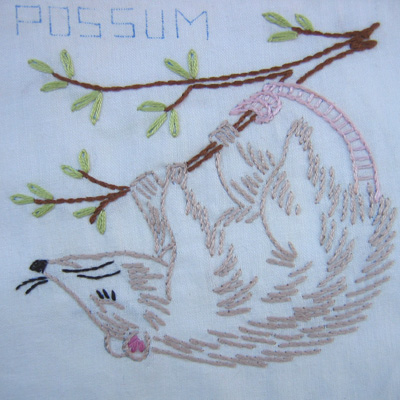
Since I'm usually exhausted by the late afternoons, I spend an hour or so resting my back and working on the embroidered quilt blocks. The light is really beautiful and perfect for embroidery at this time of day, too. I'm making good progress and the possum and bear are just about done.

bear
Everything but the eyes and word.

possum
Just hanging around.

I had an email from Jenny this afternoon—she saw the original blog post and loves the quilt so far!

9.18.2008

fabulous

My latest Ebay vintage fabric purchase...

vintage fabric

Luckily this was a buy now auction so I didn't have to bid! It's a very finely woven combed cotton that feels silky (like rayon) and there's 5 yards of fabric so lots to work with. And it had the original label—06 0795 Lawn Party by Ameritex United Merchants. No date but there is a zip code so it's after 1963.

Wouldn't this make a fabulous dress—from a vintage pattern, of course?

9.16.2008

Jenny's quilt

OK, the baby quilt.

My friend Jenny had just painted her guest bedroom coral and then she found out she was pregnant. And didn't want to repaint so the baby's room will have coral walls. Blue or pink is so traditional, but I love people who do the unexpected when it comes to decorating! And I had (I thought) the perfect thing to make a baby quilt with—a vintage baby sheet with ducks. I'd begun the embroidery last year and the feet were coral and a perfect match. But, then she found out it was going to be a boy. And suddenly the ducks didn't seem very "boy". Hmm, what to do?

IMG_3843
A partially completed block.

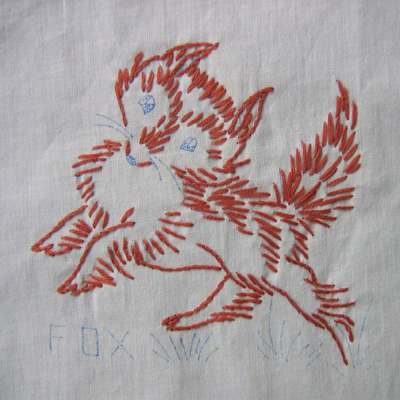
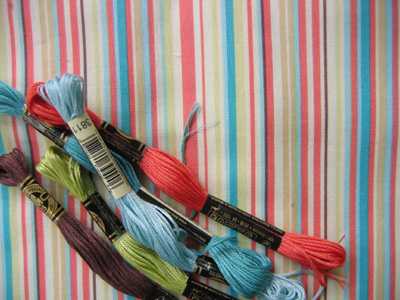
So, we looked through all my embroidery projects and found a set of quilt blocks with animals. That didn't help much with the coral but it was a start. We couldn't find anything suitable in my stash of fabrics (everything with coral was too flowery) but the very next day I received the Hancocks of Paducah catalog in my mailbox and I found the perfect coral striped fabric. It also has pale green, light blue, turquoise, and brown—since many of the animals will be brown, that works well. I also ordered a green fabric with white dots as the secondary fabric. That's backordered but I suspect it's not going to match very well. But I have an alternative—Michael Miller's Dumb Dots in brown. She tells me that the furniture will be dark wood so I think this will look better.

IMG_3836
The fabric and some of the embroidery colors.

Except for the second fabric choice, things were coming together. At least enough that I could start the embroidery. I'm sticking with realistic colors for the animals, the leaves will be green to match one of the stripes, and the flowers (there are just a few) will be done in coral. I got to use a little blue for the water the hippo is sitting in, but there won't be much opportunity to use that color again. I'm saving the words for last and will do them in coral or turquoise (or perhaps a combination) to work in a bit more color.

IMG_3841
Another partially completed block—the only block with water.

I have a long way to go but I'm trying to get an hour or so of embroidery done every day and it's coming along. This is the part that will take the longest. I don't anticipate problems with the fabric piecing but I haven't decided how I'll quilt it yet. I'd like to do it with brown top-stitching, or by adding flat brown buttons in the corners (although that's probably a no-no for a baby quilt). If I run out of time, I'll hand-tie it. I have until Christmas, which seems like a long time. But I'm still wondering how it got to be halfway through September already?

IMG_3839
I'm working on the leopard spots now.

I'll update on my progress as I go along.

9.12.2008

the process

JZ asks, I'm interested in the process you use to select the components in your design - hankie, fabric, lace edging, buttons. What's first? How long does it take to reach the point where you say,"yea, that's it"?

It feels like I must have talked about this before but after you’ve done hundreds of posts it gets kind of fuzzy and I couldn’t find anything when I searched. No matter, it’s a good subject to revisit.

I guess to start at the very beginning is to talk about shopping. Whether I'm at an antique mall, flea market, or yard sale I'm always on the lookout for handkerchiefs to add to my stash. If the price is right I always buy plain white ones with colored crochet edgings — these get layered under the printed and embroidered ones. For the hankies that go on top, I buy ones that catch my eye. Maybe it features a flower I'm particularly fond of, a cool technique (like the appliqued butterfly shown below), or a print that matches a fabric I have at home. It's hard to explain but they speak to me.

butterfly sachet
I like to use visual "tricks" like the diamond-shaped button that echoes the butterfly wings.

When I get them home and cleaned up (soaked, washed and ironed, if needed) they get added to a box with the others. This is the first thing I pull down from the shelf when I get an order for sachets. The next step is to match up a hanky for the top layer with one that has a crochet edge for the bottom and that's simply a visual thing. I look for a color match but not necessarily with the predominant color. Sometimes it's better to choose a color that you only see small amount of. Like the coral from the gray edging shown here. Once I have a good combination I go to my fabric stash to see what will work with it. Again, that’s usually a color thing. But I might match a flower or choose a polkadot fabric if there are dots in the print. Sometimes I'll find a fabric that's perfect with the hanky but doesn't look good with the crochet so I might change my mind.

roses sachet
I played up the coral thread running through the gray crochet edging with the rose print hanky on top and continued the rose theme by using a rosebud striped fabric underneath. A matching coral button is layered over a plain white one.

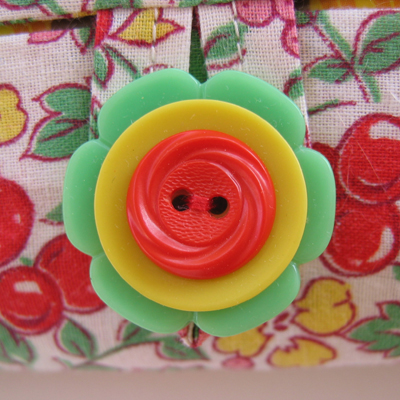
Buttons are the last step and can be challenging. Not only am I looking for a color combination that works with all the other parts but the buttons have to fit together and stack well. Otherwise they'll slide around when sewn down. Sometimes I’ll have the perfect button to match a flower in the hanky. Often I have to try lots and lots of combinations. I try to keep a good supply of large flat buttons and ones with an inset on top for the bottom layer. Small pearl and baby buttons can be good choices for the top layer. Bright colors are always good!

button stack
This is actually from one of my tissue cozies but same idea.

button stack
A stack of three with a pearl baby button on top.

Sometimes the planets align and all the parts come together quickly. I just know. But often I let the materials sit on my work table overnight and revisit my choices the next day. If I’m still happy with it then I’ll go ahead and start cutting. Once in a while I shake my head and wonder what I was thinking! Then I might try another fabric or start over from the beginning. It’s really very intuitive and I try not to force it even if I’m on a deadline and need to make a large quantity.

turquoise stripe
My favorite hankies are the brightly-colored ones. I used a turquoise stripe fabric underneath but (in hindsight) this may have worked better with a bright yellow stripe or dot fabric, although I may not have had one at the time. I did pick up some of the bright colors in the buttons.

That's it. And this is pretty much the same process I use to choose materials for all of the creations—tissue cozies to pillows. It helps to have a good eye for color but that can be learned with practice. And, if you don't have a large stash of materials at home, take your hankies to the fabric store and see what you can find. I do this all the time :)

9.10.2008

new sachets

A few of the sachets I mentioned in passing the other day.

butterfly sachet

red floral sachet

Two dozen of these are headed to a shop in California. And my supply of hankies is getting seriously low - time to go shopping, I think!

9.08.2008

busy

blue morning glory
A morning glory from my garden—what a color!

I really didn't mean to be away for so long, but I got caught up in the presidential conventions and the train wreck that followed.

And I've been busy with projects around the house, including making tomato sauce from the onslaught of ripe tomatoes in the garden; picking, shelling, and freezing lima beans (or butter beans as my friend from Georgia calls them); and painting furniture - black for the dining room chairs and table legs and hibiscus (a screaming hot pink) for a guest bedroom chair. I'm also stripping paint (a really ugly mustard yellow) from the three-paneled mirror I bought a couple of years ago. Cool to discover that, when I took the glass out, 1942 is stamped on the back! Oh, and I made two dozen sachets for a wholesale order and I'm sewing curtains for the bedroom. I know, whew!

I hope to finish up most of these projects this week. Then I'll take some pictures of my new embroidery/sewing project - a baby quilt for my friend Jenny who is pregnant with her first. It's a boy and she's got an unusual color scheme going on so choosing fabrics has been a challenge. But I think we've got it now. Still waiting for some backordered fabric to arrive then I'll know for sure. I'm using some vintage stamped quilt blocks with wild animals and most have lots of brown in them. That should help keep it more "boy".

Pictures of work in progress next time!

8.26.2008

art quilts

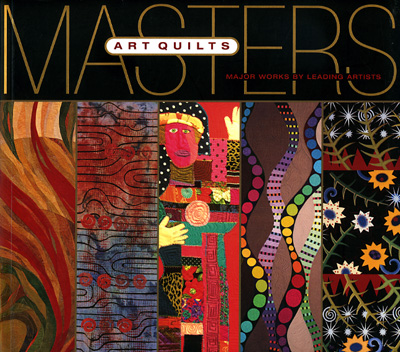
This is a very cool book for inspiration...


Masters: Art Quilts: Major Works by Leading Artists, Lark Books/Sterling Publishing, New York/London ©2008

I discovered it on my last trip to the library and I'm drooling over the gorgeous art quilts. These are not your typical patchwork quilts—they're more like paintings or sculptures. Experimentation is key and the use of non-traditional techniques is common—untraditional shapes, fabric manipulation, collage (layered fabric and found objects), surface decoration (hand and machine embroidery), and the use of photographic imagery.

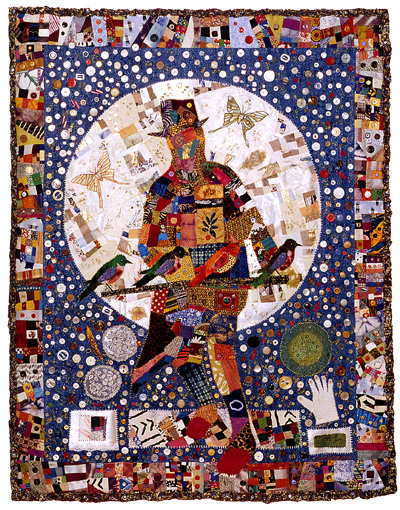
I particularly love the work of Jane Burch Cochran whose quilts are heavily embellished with paint, embroidery, beads, buttons, and found objects (gloves feature prominently) all sewn to a free-form strip-pieced base.

"My quilts are considered narrative because some of the imagery is recognizable. The quilt does not usually tell a particular story—it's left to viewers to see and translate what they will. My quilts are highly embellished with beads, buttons, and paint to enhance the narrative with a unique and personal texture."


Moonlight, 2007, 77 x 61 inches. Photo by Pam Monfort.

I'm terribly neat with my work—perhaps too much so—and viewing quilts like these lets me now that it's OK to be get a little crazy sometimes. I do need to work on breaking out of the box a little more :)

8.21.2008

the best for last

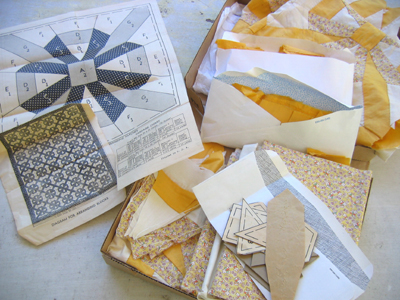
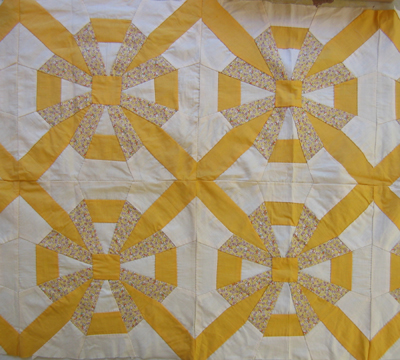
This is by far my best find at last weekend's show. I had picked up some fabric and aprons and was waiting for the vendor to finish with some other customers when I spotted a box on the table with some patchwork peeking out. Opening it, I discovered the makings of a patchwork quilt. Some blocks were done, some were combined into rows. There were envelopes of templates, the original printed patterns, and lots of cut out pieces. At the bottom there was even extra yardage of each fabric.

the box

My heart skipped a beat. Then I thought, "no way will I be able to afford this." But it never hurts to ask, right? So I did. $35. Can you believe it! I saw the person standing next to me ear's perk up and I grabbed that box so fast it wasn't funny.

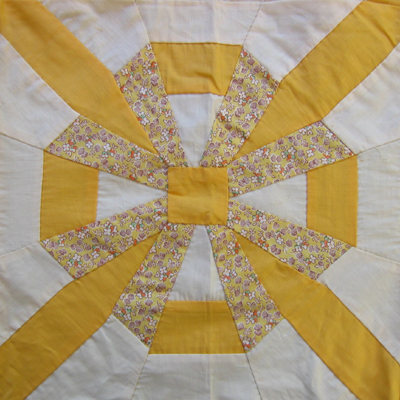
single block
A completed block

four blocks combined
Four blocks combined

On further inspection, everything seems to be there to make a good-sized quilt. What's done so far is hand-sewn. And everything is really clean and just about perfect.

the back
such neat hand-stitching

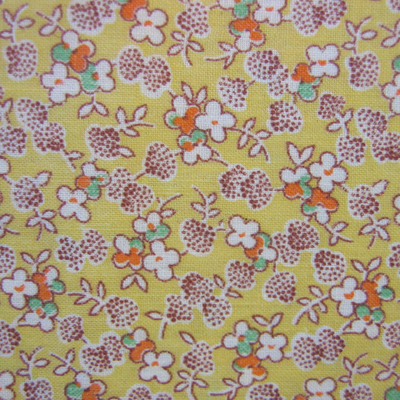
fabric
A closeup of the print

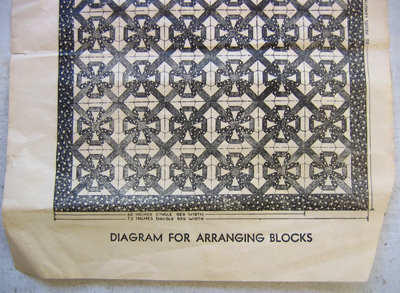
The only problem is that I can't figure out the pattern. I've looked in all my quilt books and I'm coming up with nothing. I know that some creative quilters designed their own patterns but this appears to be a commercial one. And not one that appeared in a newspaper—there's nothing on the backs of the patterns. I'd love to know what the pattern is called so I can do some research to determine how old this is. Can any of you quilters help me out?

block pattern
The block pattern

quilt pattern
The diagram for arranging the blocks

8.20.2008

another find

children's hanky

It's not so much that this vintage children's hanky is in perfect shape—it isn't. The fabric is thin and almost worn through in a couple of places near the edge. But the colors are still bright and the motifs are super cute so I had to buy it. And it was only $3.

The words in the center read: On Monday I wash my little dolly's clothes—How she gets them so dirty—Goodness knows!

children's hanky

There are tiny washboards and boxes of soap flakes and little blue soap bubbles scattered around. And the little girl with her braid and blue bow is super cute!

children's hanky

children's hanky

children's hanky

I'm thinking of turning this design into an embroidery pattern! Or perhaps a fabric design.

8.19.2008

Road Trip: Madison-Bouckville Antique Show

After a two-hour drive, half of it through dense fog (hate that) along Route 81N in Pennsylvania we finally arrived at the show. We got a great parking spot (completely by accident since you have to park where they tell you to) just a few rows over from the south gate! Then we headed to the back so we could hit the tents first. The tents can get so crowded later on that it's almost impossible to move or look at anything and there were a couple of vendors that I specifically wanted to visit. That done, we circled around the back and up and down the rows and by lunchtime managed to hit everywhere except the front section. We figured we'd have lunch and then go back. We were just packing up the lunch stuff when the raindrops started. One look at the sky (a sickish green-gray color) and the fact that lightening and thunder had already started convinced us that waiting it out wasn't going to work. Much as I hated to do it, we left.

So, for the first time ever, I didn't spend all the cash I'd budgeted for this show. But I got plenty of great stuff in the morning. And who knows, maybe I wouldn't have found anything else even if we had gone back. At least that's what I tell myself :)

It was a vintage fabric kind of day and I got lots of great prints. Like this floral that looks like barkcloth but isn't. The background is the prettiest peachy-pink color—
floral

I also found a fun design with black line birdcages and orange, dark red, and avocado green birds—
birdcages

And I love the colors on this Waverly Bonded Glosheen fabric—aqua geraniums with lime green flowers and lavender sprays—
vintage Waverly

Some of my favorite vendors didn't have any buttons this year so these are the only buttons I bought—
vintage buttons

I'm starting to love these cute little beaded coin purses and found two —
coin purses

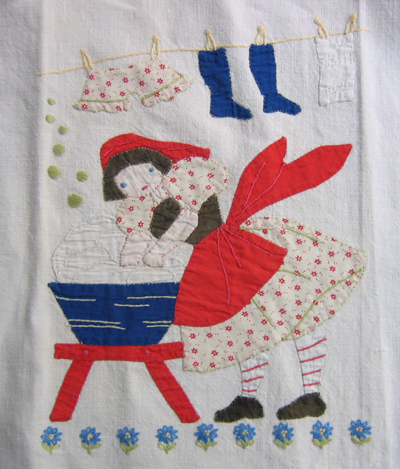
I also love appliqued things and found this great towel of a woman washing and hanging clothes—
washerwoman

Here's a closeup of the appliqued pantaloons hanging on the clothesline—aren't the embroidered clothespins great?
washerwoman detail

I got a few aprons, including another with chicken scratch embroidery. I'm seeing that everywhere these days!
chicken scratch

I'm going to save my best finds for future posts—both deserve more attention since they're so cool. Stay tuned :)

8.15.2008

Don't forget the Madison-Bouckville Outdoor Antiques Show this weekend. If you've been reading my blog for a while you'll know that I've gone to this show every year for the past three years. It's a very big, very tiring-to-walk-through show (90 acres! 1000 dealers!!) but I always find great stuff and I wouldn't miss it for anything.

If you've just started reading, here are my 2007 and 2006 posts about it. I guess I didn't write one for 2005.

I've been so good this year — not attending many shows and generally cutting back by not buying things I don't need. This show is my weakness so I may be bad this weekend :)

Rather than battle the lines at the food stands or try to find a restaurant in a nearby town for lunch we're bringing a picnic basket this year. We usually make a few trips back to the car anyway, so we'll plan one around lunch time. Not sure what that basket will contain just yet — except for the fresh peaches I got at the farmer's market a few days ago!

Will let you know how it went next week, hopefully with lots of great pictures of my finds :)

8.13.2008

pansy

I showed you an embroidered quilt block of a violet last week and this is another block from that same set. You're probably wondering why I chose such unpansy-like colors for the embroidery. I'll show you why in a minute.

pansy

I found a vintage pansy border-print pillowcase at a flea market earlier this year and I was immediately attracted to the colors. This is a closeup of the edge. Not traditional at all but what a great combination—I love the soft gray with the pink and red and green.

pansy border fabric

So, when the flower blocks arrived I thought "what a great pillow the pansy block would make combined with that pillowcase." And I embroidered it to match. I'm still considering the buttons—the ones in the picture matched perfectly in my studio but not when I took everything out into the daylight to be photographed. I may change my mind.

pansy pillow fixings

You can find a free traceable pattern for the pansy here and the entire set of patterns (pansy, violet, wild rose, ox-eye daisy, poppy, and buttercup) for sale on my website here.

8.11.2008

unusual embroidery

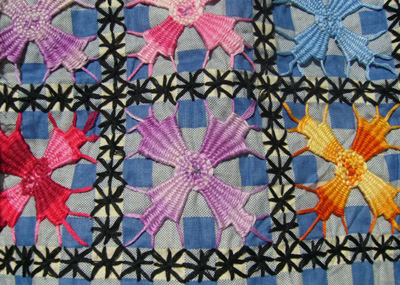
Last week, Janice sent me a photo of a piece of embroidery she found at a folk art/fabric art store where she lives. She wondered if I'd ever seen anything like it before. And I hadn't, although we both agreed that the center looked like the spider web stitch. I assumed it was some variation of that stitch and asked if I could post the photo on my blog to see if any of my readers had any info on it. Sometimes there are regional variations on stitches and I know I have a lot of readers who live in foreign countries. You never know.

So, this is the stitch...

Isn't it cool?

Janice emailed me back later to tell me that she thought it was called tenerife. I did a little research and it seems that the original technique is Spanish—from the Canary Island of Tenerife specifically—and is indeed called tenerife, or Sol Lace (more examples here). The base threads were originally stretched across pins with the cross threads woven into them. And the resulting lace is very delicate and pretty.

Janice's example, which has the base threads in the fabric corners and uses embroidery thread, seems to be a less delicate variation. At some point in history the Spanish introduced the original technique to South America and in Paraguay it's now called Ñandutí lace. Ñandutí means "spider web" in Guaraní, the official, indigenous language of Paraguay. Perhaps this is the variation we're seeing here.

Ruth, at Needlpointers.com has some examples here. (warning - music on the page)

Some instructions for a Teneriffe Lace Christmas ornament. And a butterfly design.

Have any of you tried this or know anything more about it?

*Updated to add a direct link to Deepa's blog post about Kamal Kadai, an Indian surface embroidery technique that looks a lot like our picture. Thanks for commenting, Deepa!

not a hummingbird

hummingbird hawk moth
Although it hovers and hums when it feeds on flowers just like one. This is a hummingbird hawk-moth (Macroglossum stellatarum) feeding on my butterfly bush. We have hummingbirds, too, and I've seen them fighting with these moths over the bee balm in my herb garden. Nature in action :)

8.07.2008

August, already?

What is it about this summer? It's happening so fast! Sorry for the lack of blogging last week. The garden has been occupying a lot of my time—colanders full of green beans and piles of cucumbers to deal with. And the corn and tomatoes are coming quickly. So much outside stuff to do.

beans & cukes

But, in case you think I haven't been doing anything fun, here are a couple of those embroidery projects I promised to show you earlier this summer. This first one is a vintage Vogart quilt block of violets. I bought a set of these (six flower designs) recently on Ebay and embroidered this first because I have some matching fabric and plans for a pillow. I finished the top yesterday and should have the completed pillow up on my site soon.

violet

This little cowboy quilt block (complete except for French knots on his shirt) will be combined with a vintage red bandana print for a future pillow.

cowboy

I've also been working on this sweet blue dotted flannel baby cover with kitties and strawberries. I know, what self-respecting cat would eat strawberries? But, it is cute, even if it stretches reality a bit :)

brown cat

There are three cats in all plus butterflies, small patches of strawberries, and little flowers, all set in an oval shape in the center. It's big and taking a while so I alternate this with other projects that are more quickly finished.

orange cat

It's been a weird summer for sales. I haven't been making new pillows at all, or anything else handcrafted because no one is buying right now. People have other priorities—like food and gas—believe me, I get that. I have been selling tons of vintage buttons and fabric (who knows why?) so I've been keeping those sections stocked with new items. Also added are a batch of vintage crochet pattern books and some cute vintage baby things, including embroidered bibs, a Bambi crib sheet, and a pair of green wool mittens embroidered with ice skaters!

7.22.2008

a cat speaks

This is how I deal with the heat...

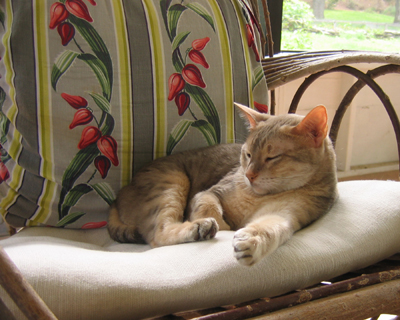
amaya

By sleeping. Of course, that's how I deal with most things, but the screened porch is especially nice for a nap when it's hot. You can't see it in this picture but there's a ceiling fan right above me to keep the air moving. And I love this pillow cover that my mom got at the flea market. She says it's not bark cloth but I wouldn't know anything about that. Bark makes me think of dogs and I'm not so fond of dogs.

I didn't know blogging was so much work. Yawn. Time to go back to sleep...

~ Amaya

what to eat when it's too hot to eat

It's been unbelievably hot here the past few days—in the 90s! Thankfully it does cool off a little at night and stays cool for a few hours in the morning so I can get some work done early. After that it's too hot to move. Eating is always a problem when it's really hot. Who wants to add more heat to the air by using the stove or oven? And who want to eat something heavy? I've been turning lately to salads.

Over the weekend I made a nicoise salad with baby green beans from the garden. I've been making this salad for years and have lost track of where I got the recipe, so apologies to whoever the original belongs to. There's some prep work and use of the stove involved but you can do that ahead of time.

Salad Nicoise

3/4 cup olive oil
1/4 cup red wine vinegar
1 clove garlic, crushed
1 tablespoon chopped fresh basil (1 tsp. dried)
3/4 teaspoon salt
1/2 teaspoon dry mustard
1/4 teaspoon cracked black pepper
1 large head Boston lettuce
1 pound small new potatoes
1 pound fresh green beans
3 hard-cooked eggs
1 medium red onion
2 medium tomatoes
1 red bell pepper
Two 7-ounce cans water-pack tuna
1/2 cup pitted ripe olives

1) In a jar with a tight-fitting lid, combine the oil, vinegar, garlic, basil, salt, mustard, and pepper. Shake vigorously and refrigerate.
2) Wash lettuce; remove core and drain well. Separate into leaves.
3) Scrub unpared potatoes. Place in a medium saucepan, add boiling water to cover and 1/2 teaspoon salt. Bring to boiling and boil gently, covered, for 20 minutes. Drain, cool and peel, then slice 1/4-inch thick. Turn into shallow dish.
4) Trim ends and wash beans. Cook whole in boiling water with 1 teaspoon salt, covered, for 5 to 10 minutes. Drain and cool 10 minutes. Turn into dish with potatoes. Add 1/2 cup dressing and toss until well coated. Refrigerate, covered.
5) Peel and quarter eggs. Slice onion thinly. Wash and cut each tomato into six wedges. Wash pepper, halve and remove seeds, and cut into 1-inch strips. Drain tuna; with fork break into chunks.
6) Arrange lettuce in a shallow bowl. Arrange eggs, onion, tomato, pepper, and tuna over lettuce and chill until ready to serve. (I hate really cold salads so I let it warm up a bit on the counter). Just before serving, spoon on the beans and sliced potatoes and drizzle the whole thing with the remaining dressing. (6)

If you want something easier (and quicker), throw together an asian noodle salad with some shredded leftover chicken, chopped veggies (I like carrot, red pepper, scallions, and cucumber), chopped herbs (Thai basil and cilantro—also from my garden), some noodles (linguine fini is good), and some bottled Thai peanut sauce. Mix it all together in a bowl and chill for a little bit in the fridge. Easy peasy! This would be fine without chicken or with the addition of some tofu for a vegetarian version.

So, what do you like to eat when it's too hot to eat?

7.17.2008

rickrack + embroidery

I promised to show you another apron that uses rickrack creatively and here it is. The technique for attaching the rickrack can be used on anything—not just gingham—but this example shows a nice use of cross stitches in between the rows. And it's another idea for trimming your gingham apron if you're doing one for the challenge.

green gingham apron
Use colored embroidery floss (same color as the gingham) across the dips in the "waves" to attach your rickrack to the fabric. Running your stitches all in the same direction gives you a striped effect; alternating direction forms a v-shaped design.

rickrack trim closeup

The apron shown here has the rickrack along the waistband and pocket tops—one row of the larger size in the center surrounded by two rows of the smaller size. Along the bottom are two rows of this same arrangement with the addition of cross stitches on the white squares in between. Looks pretty fancy but isn't quite as much work as chicken scratch!

rickrack trim